

Sarashina Diary: Retold in the present tense (9)
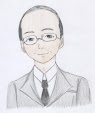
The ladies-in-waiting who are accustomed to the company of court nobles seem to attract all the attention, but nobody cares whether a simple-hearted country woman like me exists or not. On a very dark night at the beginning of October, when sweet-voiced reciters are to read sutras throughout the night, my companion—another lady-in-waiting—and I go out to the entrance door of the hall to listen to them. After talking for a while, we sit nodding and napping. Then, I notice Minamoto Sukemichi (1005–1060), whose father worked with my father in 1001, approaching the hall. "It would be awkward to run away to our room to call the more prominent ladies-in-waiting. Let’s remain right here and see what happens," says my companion, playfully encouraging me to stay. I sit beside her, listening to him.
Sukemichi speaks gently and quietly. There is nothing regrettable about his demeanor. "Who is the other lady?" he asks my companion, casting a curious glance toward me. He says nothing rude or amorous like other men, but talks delicately of the moving and sorrowful things of the world; many a phrase of his possesses a strange power that keeps me from leaving. My companion and I engage in a witty, refined exchange with him. "I did not think there would still be someone so charmingly unfamiliar to me in this residence," he says. He seems completely captivated by me and does not appear inclined to leave anytime soon.
There is no starlight, and a gentle shower falls in the darkness. Its soft patter on the leaves is utterly charming. "On a night of such deep, hidden beauty," Sukemichi says, "the full, naked moonlight would actually be mismatched. It should never be too dazzling." Discoursing elegantly upon the rival beauties of Spring and Autumn, he continues, "Although every season possesses its own unique charm, how exquisitely lovely is the spring haze! When the sky is tranquil and softly overcast, the face of the moon is not too bright, appearing as if it is floating upon a distant, misty river. At such a time, the calm, gentle melody of the lute is nothing short of exquisite.
"In Autumn, on the other hand, the moon shines with piercing clarity. Even when mists trail over the horizon, we can see things as clearly as if they are right before our eyes. The sighing of the wind, the delicate voices of insects—all sweet, sorrowful things seem to melt together. When, at such a moment, we listen to the poignant autumnal music of the koto, we think but little of the Spring.
"In Autumn, we cannot help but think that way. Yet in Winter, when even the sky looks frozen through and through, it is magnificently cold; the snow blankets the earth, its pristine light mingling with the pale moonshine. Then, when the piercing notes of the hichiriki vibrate through the crisp air, we forget both Spring and Autumn entirely." Having spun his silver-tongued tale, he turns to us and asks, "Which season, then, lingers most fondly in your mind?"
My companion answers in favor of Autumn, and I, not wishing to imitate her, reply with a tanka poem:
In the pale green night,
Flowers all melt into one,
Blending like the soft haze,
As the spring moon shines so faint.
He, after repeating my tanka poem to himself over and over, says, "Then you give up Autumn?” and replies:
If I am to live after tonight,
I will cherish the Spring,
Holding it in my heart forever
As a tender memento from you.
My companion, who favors Autumn, chimes in:
Others seem to give their hearts to Spring.
Even if it be so,
I shall remain alone,
Gazing at the lonely Autumn moon.
He seems deeply intrigued, and, as if playful yet embarrassed, says, "Even in Tang China, poets were divided between Spring and Autumn. Your choices make me think that there must be some personal reasons which make you judge in your own ways. When I feel deeply unhappy or heartily joyful, my mind inclines to be dyed with the colors of the sky, the moon, or the flowers of that very moment. I desire so much to know what inclines your hearts to Spring or Autumn.
“The moon of a winter night is usually spoken of as an instance of dreary bleakness. As it is bitterly cold at night, I had never seen it intentionally. However, I went down to Ise Province in November, 1025, to serve as the Imperial messenger at the coming-of-age ceremony on December 5th for Princess Senhi (1005–1081), the Saigu, the High Priestess of Ise. I thought about leaving for Kyoto in the early dawn, so I went to take leave of the Princess. Days of snow had accumulated, and the moon illuminated the snow with dazzling brightness. As I was on my journey, I felt very uneasy.
"Her residence, compared with others, was awe-inspiring, as I regarded it as a sacred place. I was ushered into an elegant room. There was an old lady-in-waiting who had started serving during the reign of Emperor En’yu (959–991). She looked incredibly holy and ancient. In a most refined manner, she told of the things of long ago with tears in her eyes. She then brought out a beautifully tuned Japanese Biwa lute. The music she played did not sound like anything belonging to this world. I regretted that the dawn should ever break, and was touched so deeply that I had almost forgotten all about Kyoto. Ever since then, the snowy nights of winter always remind me of that scene. I have never missed going out and gazing at the winter moon, sometimes even bringing a brazier out with me. You, too, must certainly have your own reasons for favoring your chosen seasons. Hereafter, as a matter of course, every dark night with a gentle rain will touch my heart. I feel tonight has been in no way inferior to that snowy night at the residence of the Saigu."
With these words, he departs, and I wonder if he could have known who I was.
In August of the following year, Princess Yushi goes again to the Inner Palace, where entertainment continues throughout the night. I do not know that Sukemichi is present there, and I pass that night in my own room in the Fujitsubo House. When I look out in the early morning, opening the sliding doors onto the corridor, I see the morning moon, very faint and charming. I hear footsteps, with someone among them reciting a sutra. The one who is reciting stops right in front of the entrance of the house and calls out a greeting. As I am the only one awake in the house, I reply. He, suddenly recognizing my voice, exclaims, "That night of softly falling rain—I have not forgotten it, even for a single moment! How I have yearned for you." As the situation does not permit me many words, I compose a tanka poem:
Why do you cherish so deeply
The memory of that gentle shower,
Whispering softly upon the leaves,
Lost in the fleeting mood of that night?
I have scarcely uttered these words when other people approach, and I quickly steal back inside.
After that evening, I return home. Later, I hear that he visited my companion—the one who had debated Spring and Autumn with me before—and left with her a tanka poem composed in reply to mine. According to hearsay, he said, "If there should ever be another night as tranquil as that of the winter shower, I would dearly love to play my lute for her, sharing every melody I know."
How I wished to hear him play! I waited for the perfect occasion, but alas, it never came.
In the following Spring, on one tranquil evening, I hear that Sukemichi comes to the Princess's residence. I creep out of my room with my companion—the very one with whom Sukemichi and I had debated Spring and Autumn. However, the hall is already filled with the usual crowd: guests visiting from outside and the regular ladies-in-waiting inside, all seemingly waiting with bated breath to see what will happen. Finding no quiet moment under their watchful eyes, I stop creeping forward and turn back. I fondly convince myself that he must share the very same mind as me—surely, he has come precisely because it is such a tranquil night, but has retreated simply because it is too noisy.
The tempting sounds of whirling currents
Urge a sailor to venture out to sea.
Does a beach fisherman, I wonder,
Share the very same mind as he?
Having composed this tanka poem, I have nothing more to do. His personality is, in truth, very honest and sincere; he is not just another ordinary man. Yet, time simply passes by, without him approaching me, or me approaching him.
posted by kakutaharuo | 3:13 PM

0 Comments:
Post a Comment
<< Home