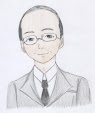


Sarashina Diary: Retold in the present tense (4)
Towards the end of April, I temporarily move to Higashiyama for a certain reason. On the way, the nursery beds for rice plants fill with water, and the fields newly planted with rice seedlings look all rather green and charming. In the evening, the mountains look dark and closer. Rails chatter noisily on such lonely evenings.
Do the water rails cackle,
As if knocking at the door to deceive,
Thinking that no one would dare venture
Into the deep mountains at dusk?
As our temporary dwelling is near Reizan-ji Temple, I go there to pray. Fatigued, I drink water from a stone-lined well in the mountain temple, scooping the water with my hand.
Another visitor says, "I could never have enough of this water."
As once Ki Tsurayuki (866–945) composes:
Before I could drink my fill,
The water scooped by my hands
Grew cloudy from a single drop—
Must we, too, part so soon in sorrow?
I decline the visitor's advance:
Do you truly believe
You can drink your fill from this mountain well,
Without causing a single drop
Of troubling cloudiness between us?
He further approaches:
Even if the mountain well
Grows cloudy from a single drop,
I would still choose to stay
And keep drinking from the spring right here.
We come home from the temple in the full brightness of evening sunshine, and enjoy a clear view of Kyoto.
The man who talked about a drop and the cloudy water goes back to Kyoto, sorry for parting from me. In the next morning, he sends a tanka poem:
As the evening sun sinks low
And the eastern mountains fade to dark,
I helplessly gaze back toward the peaks,
Longing for the place where you abide.
I hear the holy voices of the monks reciting sutras in their morning service and I open the door. It is dim early dawn and mist veils the treetops of the dark forest. The forest looks thicker than in the time of flowers or red leaves. It is slightly cloudy this lovely morning. Cuckoos are singing on the nearby trees:
I yearn for someone by my side
To behold this breathtaking dawn
In the quiet mountain village,
And listen to the cuckoo’s echoing call.
At the end of that month, cuckoos sing clamorously on trees towards the glen:
While the one in Kyoto
Anxiously awaits the cuckoo’s first song,
Here the birds sing with careless abandon
From the break of dawn until the dead of night.
One who stays with me says: "Do you have someone in Kyoto who you want to listen to cuckoos with now? Do you have someone who you want to see the mountains with now?" She composes:
Many in the capital may gaze at the moon,
But is there anyone who casts a thought
To these deep, forgotten mountains,
Or remembers us hidden away from the world?
I reply:
I know not how the moon appears
To those who watch it in the capital at night,
But surely the moonlight must shine
Upon this lonely mountain village first of all.
Once, towards dawn, I hear footsteps which sound to be those of many people coming down the mountain. I am frightened and look out. It is a herd of deer which come close to our veranda. They cry out. It is not pleasant to hear them cry nearby:
If only I heard the lonely cry
Of a deer calling for its mate
Upon the distant hills on an autumn night—
How much sweeter that melody would sound.
I hear that a certain man has come near my temporary dwelling and gone back without calling on me. So I make a sarcastic tanka poem:
Even the wind that passes
Through the pine trees on the mountain—
Though it knows me not at all—
At least leaves with a whispering sigh!
August has come, and more than 20 days have passed. The moon shines towards dawn and looks very charming. The mountainside is gloomy, and the waterfall sounds very refined. I see them quietly and calmly:
I wish that lovers of nature could see
The waning moon at dawn in a mountain village
At the very close
Of a melancholy autumn night.
I pack up our temporary dwelling to return to Kyoto. In the rice fields which were covered with water when I came here, rice plants are all harvested:
So long have I remained away from home—
Since the nursed rice seedlings in the beds
Were planted, grew,
And now have all been harvested.
When the end of October is approaching, I visit our old temporary dwelling again. The leaves of thickly grown trees which cast a dark shade in the garden have all fallen. The sight is sorrowful all over. The babbling brook which used to run sweetly is buried under fallen leaves, and I can see only the course of it:
Even the clear water cannot live on
In such lonesome, stormy mountains;
Like the drifted, fallen leaves,
My heart is also scattered and lost.
When I head back to Kyoto, I say to the neighbor nun that I shall come again the next spring if I can live so long, and beg her to send word when the flowering time comes.
The new year comes, and it is past March 19th, but she completely ghosts me, leaving me with radio silence. So I write to her:
No word has come of the blooming cherry blossoms.
Has spring not yet arrived for you,
Or does the perfume of the flowers
Fail to reach your distant home?
I set out with a heavy heart, arriving at a lonely lodging. My new room is beside a bamboo wood. The wind rustles its leaves, and the full moon disturbs my sleep:
Night after night, the bamboo leaves sigh;
My fragile dreams are broken,
And a vague, indefinite sadness
Slowly fills my waking heart.
In Autumn, 1026, I'm forced to move on from that place to stay at yet another location, and send a tanka poem to the previous hostess:
I am like the fleeting dew upon the grass;
It matters little where that dew may fall,
For to my grieving eyes,
Every place alike looks like a wasteland.
My stepmother still calls herself Lady Kazusa, clinging to her status as the former wife of the Governor of Kazusa Province, even though she now has a new husband visiting her home. My father feels compelled to tell her that such pretension is no longer appropriate. Alluding to the famous poem by Emperor Tenji (626–672) about the rustic palace of Asakura, he sends her a reply:
The rustic palace of Asakura is now a cloud-veiled memory,
Yet like a guard blaring his name into the night,
Why do you still loudly proclaim that faded title of yours,
Long after its proper season has passed away?
Worrying about these tedious, rambling family chores is all I do. The few pilgrimages I make fail to turn my mind toward the religious devotion expected of an ordinary person. Many ordinary girls these days start reciting sutras or engaging in serious practices by the age of seventeen or eighteen, but I cannot even imagine doing so. My mind is filled with nothing but fantasies: I yearn for a noble, handsome man like the Shining Prince Genji to visit me, even if only once a year. Like Princess Ukifune, could I be hidden away in some secluded countryside, gazing at blossoms, autumn leaves, the moon, and snow? Could I pass the days waiting for beautifully written love letters, steeped in a world of romantic loneliness and helplessness? That is the only future I envision for myself. I tell myself that if my father could only win a prestigious post, I might also enter into a much nobler lifestyle. Such unreliable, idle hopes occupy my daily thoughts.
At last, my father is barely appointed Governor of Hitachi Province—a post located in the remote East. He does nothing but complain, saying:
“I always thought that if I could secure a governorship near Kyoto, I could finally take care of you to my heart's content. I wanted to bring you along to see the beautiful scenery of the sea and mountains, and I wished for you to live a life of comfort, attended by servants far beyond our current modest status. It seems the karma from past lives is poor—not just mine, but yours as well, which is why we are in this mess. To think that after waiting for so long, I must go to such a distant province! When you were a small child, I took you with me to Kazusa Province. Back then, even a slight illness made me terrified that if I died, you would be left to wander helpless in that remote land. A strange province is full of dangers; I would have traveled with a lighter heart had I been alone. Because I dragged my entire family with me, I could neither speak nor act as I wished, and I always worried that you felt miserable. Now you are grown. If I were to take you to Hitachi, I cannot be certain I would live long enough to bring you back to Kyoto.
“It is difficult enough to be fatherless in the capital, but the most wretched fate of all would be to end up stranded in the eastern provinces as a mere country woman. We have no reliable relatives in Kyoto to look after you, yet I cannot turn down this appointment after such a long wait. Ultimately, you must remain here while I depart for a long, uncertain journey. Oh, how on earth am I to ensure you can live in Kyoto with any shred of decency?”
Night and day, he laments, saying this and that. I can no longer care about flowers or red leaves, grieving sadly, but there is no help for it.
He goes down to his post on July 13th, 1032. For five days before he leaves, he can hardly visit my room, for he finds it too painful to see me in such a panic.
On that day, everything is in a state of utter confusion. When the time for parting comes, I lift the blind and my eyes meet his. My tears drop down. Soon, he leaves. My eyes are dim with tears and I throw myself down on the floor. A servant, who has gone to see him off, returns with a tanka poem written on a piece of paper napkin:
Were I but blessed with higher rank and state,
I should not have to face this cruel fate,
Nor ever know, in autumn of my years,
This sad departure, blinding me with tears.
My tears cloud my eyes, making it hard to read the poem to the end. In happier times, I have often composed halting tanka poems, but I have no idea what to say in such grief:
Never, in all my thoughts, did I foresee
A time when we would thus divided be;
To part from you, my father, in this world,
Leaves my young heart into the darkness hurled.
Without my father, few people visit our home. I am very lonely and forlorn, musing and guessing where he might be at every moment. As I know the route he is taking, I find myself missing him so deeply and feeling so utterly helpless. To think I used to take my father’s presence for granted—now, from morning until evening, I stay looking towards the skyline of the eastern mountains.
posted by kakutaharuo | 2:30 PM

0 Comments:
Post a Comment
<< Home